Get A Quotation For Your Warranty Or Service Contract


BEGINNER’S GUIDE TO DUNE DRIVING AT LIWA FESTIVAL 2025
If you’ve never driven on sand before, Liwa is the place that can either make you fall in love with off-roading… or make you question every life decision you’ve ever made (usually right after you bury your tires to the chassis). The good news: dune driving is a skill, not a talent. With the right prep, the right mindset, and a bit of humility, you can have an amazing first experience at Liwa Festival without turning your SUV into a sand sculpture.
This guide is written for total beginners. No “just send it” advice. No macho nonsense. Just practical steps, safe techniques, and the little details that keep your trip fun, controlled, and memorable.
What Makes Liwa Different
Liwa sits on the edge of the Empty Quarter (Rub’ al Khali), where dunes are bigger, softer, and more dramatic than most people expect. That means:
- Sand can be powdery and deep, especially later in the day.
- Dunes can have sharp drop-offs on the far side.
- Wind changes the surface constantly, so yesterday’s “easy route” may be today’s trap.
- Phone signal can be inconsistent depending on where you are.
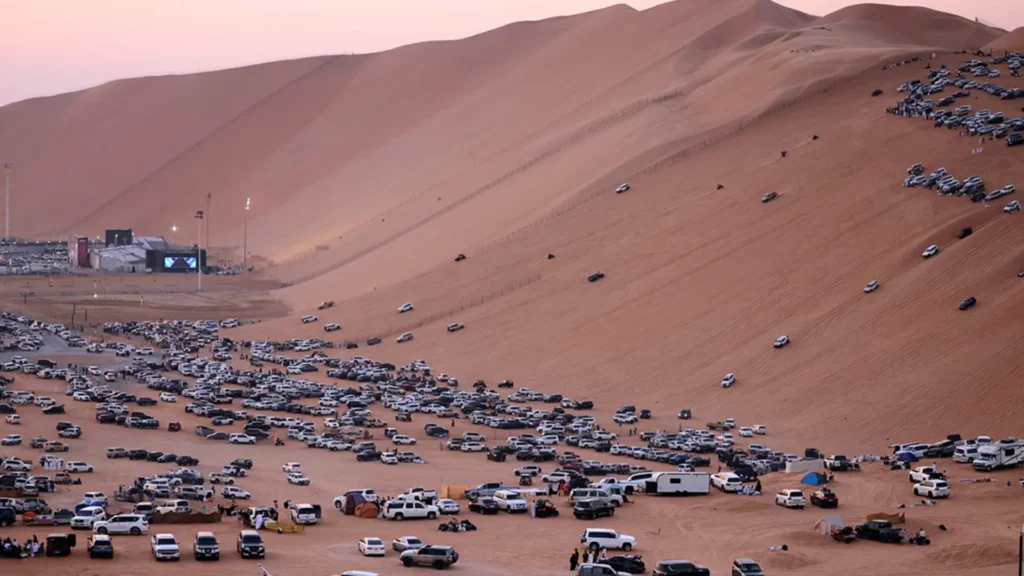
Liwa Festival adds another layer: more vehicles, more spectators, and more “I saw a guy do it on Instagram” energy. The desert doesn’t care about Instagram.
Before You Even Touch Sand: Mindset Rules
1) Leave the ego at home
The desert rewards patience and punishes overconfidence. Your goal is not to prove anything. Your goal is to return with your bumper still attached.
2) Start small, build up
Begin on flat sand and gentle dunes. The big faces and steep bowls can wait until you’re comfortable controlling traction and momentum.
3) Don’t drive alone as a beginner
If you’re new, go with a convoy or at least one other vehicle with recovery gear and experience. Solo dune driving is where “minor mistakes” become “call someone with a tractor.”
Choosing the Right Vehicle (and What Not to Bring)
Best beginner choices
- Proper 4x4 with low range: Land Cruiser, Patrol, Wrangler, Prado, Fortuner, Pajero (well maintained), similar.
- Stock is fine if it’s healthy. You don’t need a monster build.
What makes it harder
- Heavy vehicles with street tires
- Low-profile tires and big rims
- Worn suspension, weak cooling, old battery
- Full-size luxury SUVs with lots of weight and delicate bumpers (possible, but not “beginner-friendly”)
Please don’t do this on your first Liwa trip
- Take a 2WD and hope for the best
- Take a crossover and assume “AWD is the same”
- Bring a sports car for “just a few photos in the sand” (photos are expensive when you’re stuck)
The Non-Negotiable Prep Checklist
1) Tire pressure: your sand superpower
For sand, you reduce tire pressure to increase the tire’s footprint.
Typical starting point for beginners:
- 14 to 18 PSI for most SUVs on standard all-terrain tires
- Heavier vehicles may need slightly lower
- Very low pressures increase the risk of popping a bead, so don’t go extreme as a beginner
Rule: If you’re struggling for traction, don’t instantly use more throttle. First, check tire pressure.
2) Bring the right basic gear
At minimum:
- Tire deflator + pressure gauge
- Air compressor (to reinflate before road driving)
- Recovery strap (rated, not a cheap tow rope)
- Soft shackles or rated bow shackles
- Shovel (your best friend)
- Traction boards (optional but very useful for beginners)
- Flag and pole (helps others see you over dunes)
- First-aid kit, water, snacks, flashlight
3) Check your vehicle health
Before heading out:
- Coolant level, no leaks
- Engine oil at proper level
- Battery in good condition
- Tires not bald, no sidewall damage
- Brakes functioning and not overdue
- No overheating issues (sand + slow speeds + load = heat)
4) Know how to use 4H and 4L
- 4H (high range): most general sand driving
- 4L (low range): recoveries, steep climbs at low speed, controlled descents, slow technical sections
If your vehicle has traction control settings, learn the basics:
- Some traction control systems help on sand.
- Some kill momentum by cutting power.
- Test what works in a safe flat area.
Liwa Festival-Specific Tips (So You Don’t Get “Festival Trapped”)
Arrive early
Sand is typically firmer in the morning. Later, it gets churned up and softer as more vehicles pass through.
Don’t follow random tire tracks blindly
Tracks can lead you straight into a soft pocket, a bowl with no easy exit, or a steep drop-off you can’t see until it’s too late.
Respect zones and marshals
Festival areas often have controlled sections and spectator zones. Stay within allowed areas. The desert is huge, but safety perimeters exist for a reason.
Beginner Sand Driving Techniques That Actually Work
1) Smooth throttle beats loud throttle
Sand driving is about controlled momentum, not aggression.
- Too little throttle: you bog down.
- Too much throttle: you dig holes and sink faster.
Aim for a steady, clean pull. Think “glide,” not “launch.”
2) Momentum is your currency
On sand, momentum helps you float. But momentum without control becomes speed. And speed plus dunes equals damage.
A good beginner rhythm:
- Build speed gently on flat sand
- Maintain steady throttle on climbs
- Ease off slightly near crests
- Never floor it at the top of a dune
3) Steering: smaller inputs, bigger results
Big steering inputs scrub speed and increase the chance you plow the front tires.
- Look where you want to go
- Turn smoothly and early
- Avoid panic turns on soft sand
4) Cresting dunes (the part that breaks bumpers)
Cresting means reaching the top where you can’t see the other side.
Beginner rule:
Approach at an angle, slow down near the top, and peek.
Why?
- The far side may be steep (a “slip face”)
- There may be a car coming the other way
- There may be a drop you cannot descend safely
A clean crest is slow, controlled, and boring. Boring is good.
5) Descending dunes safely
For descents:
- Use low range if it’s steep
- Keep wheels straight
- Avoid braking hard (braking can cause sliding)
- Let engine braking do the work
If you start sliding sideways, gently steer downhill and reduce brake input. Sudden corrections can worsen it.
6) Side sloping (optional for beginners)
Driving across a dune face is called side sloping. It can be stable if done correctly, but it’s not where beginners should “learn bravery.”
If you do it:
- Avoid steep angles
- Keep steady throttle
- Don’t stop mid-slope
- If you feel traction breaking, steer downhill gently and exit the slope
How to Avoid Getting Stuck (and What to Do When You Do)
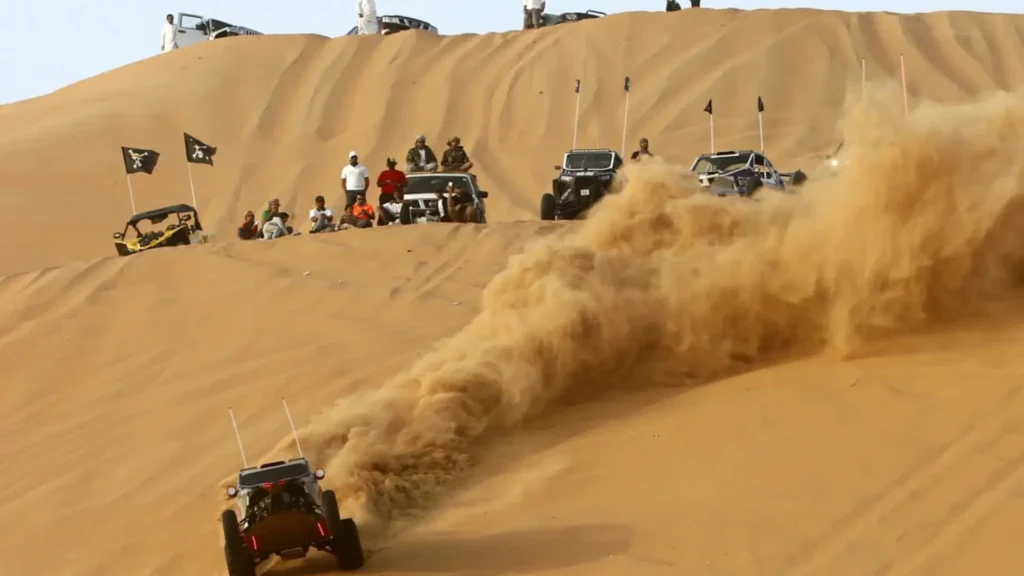
Common reasons beginners get stuck
- Tires not deflated enough
- Stopping on soft sand
- Too much throttle causing digging
- Trying to turn sharply at low speed
- Climbing too steep, too slow, then losing momentum
The moment you feel you’re sinking: stop spinning
Wheel spin digs you into a deeper hole.
Do this instead:
- Stop, breathe.
- Straighten the wheels.
- Reverse gently along your own tracks.
- If that fails, get out and check sand depth.
Basic self-recovery steps
- Shovel sand away from the front of all four tires and under the chassis if it’s resting on sand.
- Lower tire pressure a little more (within reason).
- Use traction boards if you have them.
- Gentle throttle, straight wheels, slow climb out.
If you need a strap pull:
- Use rated recovery points only
- Clear spectators away
- One person coordinates, no shouting chorus
Convoy Etiquette (Even if You’re Only With Two Cars)
Use a simple communication method
- Radios are best.
- If no radios, keep close visual contact and agree on hand signals.
Keep safe spacing
Dunes hide vehicles. Leave room so you can stop or change line without a surprise meeting at the crest.
One car at a time on tricky sections
If someone is climbing or descending a steep face, don’t follow directly behind. Give them space to recover or reverse if needed.
Safety and Comfort: Don’t Skip These
Water and snacks
Desert air is dry and you don’t notice dehydration until you’re already slow and cranky. Bring more water than you think you need.
Sun protection
Hat, sunscreen, sunglasses. You’ll be outside more than you expect, especially if you’re recovering.
Seatbelts always
Dunes can bounce you around. Seatbelts are non-negotiable.
Don’t drive fatigued
Sand driving needs attention. If you’re tired, stop, rest, and rotate drivers if possible.
A Simple Beginner Route Plan for Your First Day
Step 1: Flat sand practice (15 to 30 minutes)
- Try accelerating smoothly
- Try turning gently at different speeds
- Feel how the vehicle responds
Step 2: Small dunes
- Practice climbing and descending
- Practice cresting slowly and safely
Step 3: Medium dunes with guidance
Only move up when you’re consistently:
- Maintaining momentum without wheel spin
- Cresting with control
- Recovering calmly when you bog down
Step 4: Watch and learn
At Liwa Festival, there’s a lot to see. You can learn plenty by watching experienced drivers choose lines and manage speed without turning the day into a “crash course.”
What to Pack for Liwa Festival Dune Driving
Essentials
- Tire deflator, gauge, compressor
- Shovel, strap, shackles/soft shackles
- Water, snacks, power bank
- First aid kit
- Gloves, small toolkit
- Tow points checked and accessible
Nice to have
- Traction boards
- Portable shade
- Air down mat or knee pad (your knees will thank you)
- Extra coolant and basic fluids
- Headlamp for late-day packing
Beginner FAQs
Is dune driving bad for my car?
It can be, if you do it wrong. Smooth inputs, correct tire pressure, and proper cooling checks reduce stress a lot. Most damage comes from overheating, hard impacts, or aggressive driving.
What tire pressure is “safe”?
There’s no single number, but 14 to 18 PSI is a common beginner range for SUVs. Adjust based on vehicle weight, tire type, and sand softness. Reinflating before highway driving is mandatory.
Do I need special tires?
All-terrain tires help, but you can drive sand on good condition road tires if you lower pressure and drive carefully. The main issue is sidewall strength and heat management.
Can I take my family?
Yes, if you drive conservatively, avoid risky angles, and keep the trip comfortable. Beginners should stick to gentle dunes and controlled areas.
What’s the biggest beginner mistake?
Over-throttling. Spinning tires digs holes fast. If you’re struggling, reduce tire pressure and improve your line before adding power.
Final Advice: Make It Fun, Not Dramatic
Liwa is not a video game map. It’s real desert, real terrain, real consequences. But it’s also one of the best places in the UAE to experience sand driving properly.
Start early, air down, drive smooth, and treat every crest like it’s hiding a surprise. If you do that, your first Liwa Festival dune drive won’t just be “survived.” It’ll be the start of a hobby you actually want to keep.